THE SNEAKY SCIENCE OF STORES

“Nothing in the store is by accident.

Everything is by design.”

–  Paco Underhill (Founder and CEO, Envirosell)

The human brain is easily influenced. Thousands of years of evolution and adaption have made it unknowingly vulnerable to external cues. The hunter in us subconsciously reads these signs and prepares for action. There is a clear science behind our decisions. And this science can be maneuvered.

An inordinate amount of time is invested every year by the retail industry experts to advance and apply the scientific tactics which influence consumer choice and help stores sell more stuff.

Ten of these are:-

THE CONFUSING LAYOUT

Notice how most stores share a similar layout?

Ever wonder why the dairy section is usually all the way in the back?

The strategic placement of the dairy display case (which contains high conversion essential products like milk and butter) draws in the shoppers deeply into the store. During their journey to the back of the store in search of a must-have item, they must pass the tougher-to-sell items, sighting which increases the chance of their purchase. Some stores like Ikea have a frustrating maze-like layout to disorient customers into stop looking for what they were shopping for and jump headlong into the exploratory shopping experience. This phenomenon experienced by the shopper is known as Gruen Transfer.


The more time they spend in a store on average,

the more things they’re going to buy.

 – David Bell

Sneaky

 SHELF MANIPULATION

Stores keep expensive items on shelves that are at eye level. This is done because products at the same eye level as the customers garner psychological favor with them. Brands pay hefty premium to obtain this visibility.

This strategy is especially effective for children’s products. Take candy for example. Stores intentionally place it at a child’s eye level. Once they spot it, majority of children are likely to nag their parents to buy them that colourfully wrapped candy on a lower shelf. If you listen carefully, and over the noise of a kid throwing a temper-tantrum in the middle of a store, you may be able to hear the sound of one store marketing strategist high-fiving another.

INVITING SCENTS

Olfactory senses can be exploited with otherwise innocent holiday smells to establish an ambiance of trust.  This is why stores prefer to have the bakery located up front. The sweet aroma of the baked cinnamon-y goodness gets the shoppers to instinctually crave and buy more. Flowers at the entrance create a welcoming atmosphere and the accompanying smells comfort and sway customers to spend more time shopping.

COMPELLING OR CALMING MUSIC

Studies show music affects purchasing habits. Slow music blaring from the store speakers slows down the time for the shoppers, who thereby spend more. In an attempt to increase sale of expensive items, stores have been known to resort to Classical music as well.

RESONATING COLOUR

Colour is responsible for roughly 62-90% in the making of a first impression, say researchers. Different colours hold different associations. When Heinz changed the ketchup colour from red to green, they noted over $23 m in sales in the first month itself, higher than ever.  The experiment found that the customers associated the colour green with health, wealth and peace.

Sneaky1

FREE SAMPLES & SHOPPING CARTS

As a supermarket customer yourself, you may have experienced feelings of gratitude towards the establishment for graciously providing you with amenities of convenience that are shopping carts. You may have even marveled at their generosity when they shower you with freebies at the sample stations. In reality, store management is a little more selfish. The large sizes of the carts encourage addition of more stuff in order to fill it up as much as possible. Free goodies, on the other hand, aim to please only to invite off-the-list purchases. A sweet treat can “activate goals associated with indulgence… and encourage subsequent acts of indulgence” concludes Journal of Consumer Research.

CHECKOUT COUNTER

The checkout counter strategically plays on people’s impulsive natures. Knick-knacks are displayed at the last station of the shopping experience because the customer is quite likely to pick them up due to the build-up of a sense of urgency felt towards the ‘end of shopping’.

BORDERLINE STALKING i.e. TRACKING

From simple counting to complicated digital signs, sneaky stores use various methods to track and analyze consumer movement. Customized advertisement is pursued based on the analyses of products the eye visits the most. Store loyalty cards – believed to be instruments of frugality- are in fact part of a store’s active demographic data technology.

THE NUMBER GAME

Sneaky2

Discount signage and Bulk sales appeal to and turn customers because human beings are emotionally poor at mathematics.

The more-value-for-money illusion pulls them in. Just the thought of getting a good deal persuades shoppers to buy more than what they may need. 6 for the price of 5 sounds better than paying full price for just the 3 they originally came in for.

Not only this, the customers also have little fore-sight. They will buy a shirt for 5% off only to pay more later on the credit card.

The 99 effect is well known, yet effective. People tend to pay more attention to the left most digit since most reading is done left to right. Apple successfully used numbers to make its pricing seem like a steal ($499). This effect comes in handy for supermarkets and even the budget-conscious customers struggle to keep track of spending.


CLEVER LIGHTING & SHINY THINGS

Lighting can effect mood and evoke emotions. Bright lights in the fresh produce section can make the fruits and vegetables look vibrant and healthy. Dim lighting in the lingerie department implies the discreet nature of the store. Humans, like birds, are attracted to and fascinated with shiny stuff. One particular study found that pedestrians automatically stop outside a sparkling store. This may have something to with our ability to help find clean water which evolved back when the skill was a very big asset for survival.


WANT TO OUTSMART THE TRICKSTERS?

  • Always make a list to avoid hasty decisions.
  • Make the list aisle by aisle to cut down on time.
  • Shop without children whenever possible.
  • Shop at off-peak hours.
  • Never shop hungry or tired.
  • Get through the checkout area without getting distracted.

Now that you are aware of how stores use science to trick you into spending, you can gamble and hunt with the difficult knowledge that a predator is a possibility. Stay and shop as long as you feel in control. Just remember not to stay too long for the house always wins in the end.

Consider yourself shopping-savvy? Think you can see through the little tricks that retail outlets employ to increase sales? Share some of your own shopping experiences with us in the comment section below.


Contributed by Ankita Verma, IBS Hyderabad, Class of 2009


A BRIEF LOOK AT BUSINESS STATIONERY

Somewhere out there, is a communication-strategist named Megan who hands out her business cards like a boss!

Check out the clever play on words and typography.

Business Stationery

Creatively designed by Ascender, this beautiful stationery has not only increased Megan’s corporate visibility but her brand value as well. This is a just example of what properly strategized Business Stationery can do to strengthen the image of an individual/company.

Business Stationery 1

The origin of Stationery can be traced back to 15thcentury China.                                                                                                                                                                                            In those days, visiting cards essentially served as a personal advertisement tool for the upper class. They were also used as calling cards and handed out at doors of establishments with the intention of receiving meetings or to forge introductions with specific people.

During the highly elaborate reign of Louis XIV, visiting cards and letterheads depicted rank or title to effectively communicate status.

Personal stationery was largely used to maintain good social etiquette in Victorian era; for instance a letter of congratulations to the happy couple on a wedding that, unfortunately, could not be attended.

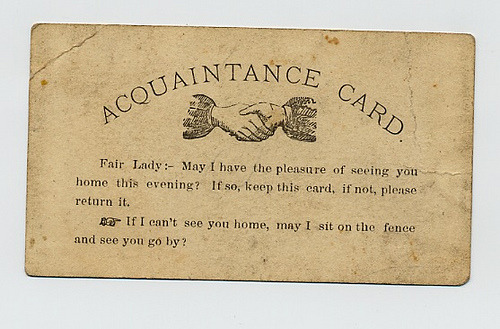
Visiting cards were frequently used by the average 17th and 18th century suitor to make acquaintance with the object of his affection and her household. Strict protocols had to be followed while delivering a card and admittance into the house would only be granted after the matriarch satisfied her inspection of it.

Business Stationery 2

Image credit

London merchants are credited with bringing stationery into the world of business. Visiting cards were employed to establish trade links and credit with other businesses. A signed card could stand in for a contract and was considered legally binding.

Today, though a business card no longer serves as an I.O.U, it is a key element in creating a long-lasting impression and improving recognition of any successful individual or business.

WHY BUSINESS STATIONERY?

Branded stationery items are tactile and personal instruments of communication.

Business Stationery 3

Yoga One business card


By its very nature, business stationery indicates a long-term and committed investment in a particular field. It is regrettable that in the ever-evolving markets, its potential as a potent marketing tool still remains underestimated.

The benefits of good quality custom stationery are many. Majorly, it:-

  1. Demonstrates professionalism
  2. Projects and promotes brand image
  3. Helps with networking
  4. Improves visibility and credibility

Not all stationery is good stationery, however. Owning stationery that is not up to standard can convey a wrong message about your product/service to potential clients and business partners.

Critics agree that no representation would be infinitely better than an off-putting one.

Business Stationery 4

Church of Scientology of California Letterhead

ELEMENTS OF BUSINESS STATIONERY

Choosing stationery that complements your corporate identity is a time taking task and rightly so.

There is a variety of elements that need special creative attention before they can work together to make agile foot-soldiers of your business stationery:

Company Logo,

Relevant Contact Information,

Uncompromised Quality,

Eye-catching Design,

Representative Font,

Brand Allied Colours, and

Empty Space

 It is important that a manager keep a note of elements that have been finalized.  As a best branding practice, these elements must be kept cohesive and coordinated across all the stationery items.

Creativity in business stationery exploits these elements and often creativity itself makes most of these dispensable.

Especially if you are Steve Martin!

Business Stationery 5

Steve Martin’s (fan) visiting card


TYPES OF BUSINESS STATIONERY

Business Etiquette for Dummies gives a list of essential business stationery:-

  • Corporate letterhead

8 1/2 x 11 inches, with the following information printed on it:

  • Business name
  • Business address
  • Business telephone number
  • Business fax number
  • Business e-mail address or web page

Envelopes are printed with the company name and address.

Business Stationery 6

Bronx Zoo’s Letterhead (Back; Front) & Envelope

  • Plain sheets of paper

8 1/2 x 11 inches; same quality as corporate letterhead

      Usage: Presented as second and subsequent pages instead of letterheads, in case of longer communication.

  • Monarch paper

7 1/4 x 10 1/2 inches

Contains the following information:

  • Person’s name, but not the business name
  • Business address

Envelopes are printed with the person’s name and business address.

Usage: Personal business letters

  • Correspondence cards:

4 1/2 x 6 1/2 inches

Contains the following information:

  • Person’s name, but not the business name
  • Business address

Usage: Personal messages and thank-you notes.

  • Business cards:

3 1/2 x 2 inches

The card should contain:

  • Person’s name and title
  • Business name
  • Business contact information (address, telephone number, e-mail address, etc.)


Apart from the above mentioned, a complete suite of business stationery would include:

  • Invoices, Receipts, Purchase orders,  Carbonless forms
  • Internal use forms – Inventory, Billing orders, Supply request
  • Labels – Shipping, Return
  • Announcement cards
  • Envelopes – Regular. Window, Return, Announcement

Business Stationery 7

One of the early Bills of Trade of a Tailoring Co.

Itching to get your own business stationery? There is a plethora of online printing services eager to please you. Before deciding on any, do your research. Give your business to the one that has the best reviews. Customer satisfaction is a good indicator of quality.

The creation of business stationery needs proper deliberation. A creative design which is both coherent and aesthetic can impress and build repute. Moreover, uniformity in branding across the stationery spectrum is more likely to convince people that it is okay for them to place their trust in you.

Business stationery does not have to be financially severe, for truly, clarity and relevancy hold more weight than extravagance. ‘Simple’ can be effective too.

Simplicity does not have to mean ‘cheap’ however.

With so many bits and pieces to be manufactured, it is a common sight to see quite a few compromising with quality in order to save some pennies. Why is it that they chose to overlook the fact that customers tend to treat a company’s stationery as a reflection of the company’s objectives, values and professionalism?

What a tragedy it is when the device of self promotion itself, misfires and misinforms!

Great care has to be taken to ensure that the subtle message delivered is in fact the intended one. Branding one’s stationery in such a distinctive manner is a grass-root marketing strategy and vital for image building. And, we can safely say that if brand image is the ‘face’, business stationery is the ‘selfie’.

Just ask Megan Sheerin.

Drop us a line in the comment section below and tell us about a piece of business stationery which you found inspiring or even disturbing. Did it alter your perception of the owner?


Contributed by Ankita Verma, Class of 2009, IBS Hyderabad


Soft Skills vs Hard Skills: Comparative Relevance for MBAs

The present-day Corporate World’s tryst with ‘Soft-Skills’ have made the term an omnipresent but hard to define buzzword. If you ask people to define Soft-Skills, you’ll by and large encounter rather ambiguous and divergent definitions. For the sake of clarity, Wikipedia defines soft skills as “associated with a person’s  EQ (Emotional Intelligence Quotient), the cluster of personality traits, social graces, communication, language, personal habits, friendliness, and optimism that characterize relationships with other people.” While Hard-Skills or traditionally known as technical skills are more closely related to a person’s IQ (Intelligence Quotient) and are defined as practical abilities learned through education and training. For example, the hard skills that an accountant would need include arithmetic, familiarity with generally accepted accounting principles (GAAP), and financial statement preparation.

got

Undoubtedly, dependency on the seemingly more-important ‘Hard-Skills’ cannot be undermined. But one thing is certain – the days of domination and exclusive control of these so-called Hard-Skills are a thing of the past. This is evident from this statement made by Harvard Business School professor in an interview. He said, “Many consultants said that technical skills – once the prime goal of executive searches – are still important but have become merely a baseline requirement.” For most jobs, while the hard skills are essential to getting into the interview, it’s the soft skills that will land the job because employers want someone who won’t just perform their job function, but will be a good personality fit for the company and make a good impression on clients.

During your entire 2 years at your B-School, you’ll observe that the methodology of teaching all the subjects is unique in the sense that in virtually every lecture, you’ll have to confront and deal with widely used ‘presentation oriented’ style of teaching. It is a precursory exercise universally adopted by B-Schools to equip their students with a blend of various Soft-Skills set, which will be instrumental for your future professional success in the severely harsh and competitive white-collar world.

For example, a project manager in an MNC, who belongs to an engineering background writes a report and assumes that people will read it – but that never happens. Because these days, however crackerjack and inch-perfect your report is – if you are not able to present your work effectively, you may never get the credit you deserve. And to be able to that with finesse you need the right kind of training and exposure beforehand. Then, with experience you can further hone and nurture those skills acquired over a period of time. That’s why the usually diffident and stand-offish but ambitious engineers invariably want to go for an MBA degree to boost their career graph by combining both their soft-skills and hard-skills. They get the best of both the worlds this way and hence an edge over others.

Just introspect – what good are great ideas if you are not able to articulate them well before the target audience. What good is your technical brilliance if your well-intentioned supervisor (Even that’s a rarity these days) does not feel confident to put you before the senior management. Moreover, Hard-Skills can be learned from books or online tutorials. Financial Accounting, for instance is a hard-skill that may be self-taught. An old-school proponent of Hard-Skills may argue that a financial accounting specialist may go on to associate himself with a CFA (Chartered Financial Analyst) and eventually become a CFA Charter-holder thereafter making a lot of moolah!

I would like to re-assert that depending on the kind of job your are in, you’ll need the relevant technical skills to get the job. However, it’s your repertoire of Soft-Skills which will actually make sure your technical skills shine and visible to your seniors and colleagues alike. A medical practitioner, for example, essentially needs to know what medicine to prescribe after an appropriate diagnosis. Isn’t it? But, in reality, which doctor would you prefer going to for a monthly regular check-up? A rude, eccentric genius who treats you like a lowbrow and attacks your ego (House MD rings a bell anyone?) OR a sufficiently qualified physician who knows you and your body well, is pleasant & courteous and takes time to answer your questions patiently? Mull over it!

Soft Skills vs Hard Skills: Comparative Relevance for MBAs

In situations like this, Soft-Skills do matter a lot. Perhaps more than you think they do. Your emotional quotient, self-confidence, presentation skills, ability to work in a team, work ethics, leadership/mentoring skills, selling skills et cetera all contribute towards a thriving career. Two vital skills hugely relevant in the present-day business enterprises worldwide and which are not included in the above list of Soft-Skills are worthy of mention here.

First one is ‘Self-Promotion’ skills. For whichever organization you are working for and regardless of who and how your boss is, just working hard doesn’t cut it. You will have to painstakingly promote your skills & working results within and even outside of your organization. You need to smartly but subtly build your reputation with the all-important people who may in any which way influence your performance review. You’ll realize that baby steps in this direction will yield rich dividends by the end of the financial year and will help you make your way up the corporate ladder.

Second important skill is ‘Managing Office Politics’, which has become a self-proclaimed but an unsaid component for professional growth and white-collar ascendancy. If you are adept in understanding the nuances of people dynamics and the goings-on inside the office premises, you will make yourself immune to discriminatory behavior and unscrupulous wheeler-dealings that sadly and surely exist almost everywhere.

Unfortunately, the significance of soft-skills is still underestimated in our country. This is where the role of MBA education comes into play. The entire MBA curriculum focuses on the skill-sets stated above. Personality development, self-awareness and increased confidence are natural by-products of a standard MBA course from a reputed B-School. Primary soft-skill attributes are inherently ingrained in its course structure and are deep rooted in its way of teaching, which is specifically adopted for the modern business world.

And it has become a prerequisite because present-day organizations expect their employees to know how to behave on the job without the need of a formal on-the-job training. They tend to assume that an employee already possesses the essential soft-skill traits in addition to the apparently more valuable hard-skills. It is a dangerous assumption which may lead to an increased attrition rate caused by non-productivity and de-motivation amongst the staff members. This preconceived perception needs to be changed.


Contributed by Pranshu Awasthi ( Class of 2007, IBS GURGAON )

Prioritizing your MBA Subject

One of the complex decision aspirants has to undergo is what to prioritize and what not when they are flooded with so many subjects, some of which is completely new to them. Adding to this, in no time they would have to give their preference for specialization. No doubt this comes after one semester, but then time flies. Some aspirants realize it at an early stage some regret it even after opting it. Such decisions once taken cannot be made retrospectively. Therefore, it is extremely important that one has to pre-plan it before the time runs over them.Prioritizing your MBA Subject

Well ,when I was pursuing my MBA, I already knew what  I was supposed to do and what specialization I had to choose. But what I could see among other batchmates were the kind of confusion they would have to live in, the confusion of what specialization to choose? One thing which many of the people inadvertently did was getting influenced either by their immediate friends or from feedbacks from seniors and super seniors. But is this the right way to go about it? Certainly, many have found it completely cherishing after graduating, but then there has been lots of “ifs and buts” to it.

My most common experience and research showedthat prioritizing a subject is ONE of the efficient ways in choosing a specialization. The context of prioritizing simply means exploring one’s interests and developing it continuously.  Prioritizing your subject is extremely crucial. Sometimes before starting the course you may not be certain what to do and where to keep the focus. Mostly with so many diversified subjects, one gets so carried away that choosing one particular specialization becomes a task. Moreover, one has to keep  pace with all the subjects else the entire score may get affected.  For some aspirants, some subjects are distinctively new and unfamiliar. Like for example aspirants from Arts who do not know about  accounts finds Accounting extremely difficult to crack.

One might think MBA course of 18 months /24 months is a long period to align the interest, but the truth is, time flies so fast that one may end up picking subjects which at the end one has to bite the bullet. In order such situation do not crop-up, one has to be focused and prioritize their subjects accordingly. One cannot be a  jack of all trades and master of none.

Identify interest areas, businesses, industry, company, fields etc. :

Aspirants have to be very aggressive after they have settled and made themselves comfortable within 15 days of the program has kick started in full throttle. They would have to start introspecting what business they would like to associate with or what industry interests them most. They would have to identify companies which they have been dreaming of to work. Some aspirants have a family business into manufacturing and he/she would  continue the legacy and therefore he/she would like to explore the same. Some have a strong preference to accounting and finance and therefore would like to get associated with financial institutions. Some have a Biotech degree and would prefer to get associated with a pharma company. Some have a strong inclination towards technology and would like to work with IT giant. Identifying such specific interest help the aspirants pursue similar subjects and prioritize the same.

Identifying skill sets, passion and aptitude:

Sometimes it so happens that aspirants are in a dilemma as to what to choose even after introspecting. In such confusing situations they should resort to identify their skill sets, passions and aptitude. For example, one may be excellent in communication and therefore he/she can explore Marketing and sales, one may be very good with creative thinking and he/she can think of Brand Management, while some are extremely quick in calculation and one can explore Finance. One may be good with operations and subsequently keep focus on similar subjects. So in short aspirants have to invest time in themselves in order to determine which subject to focuson.

Reading and reference:

Once the interests are shortlisted,  aspirants would have to now explore these areas in several ways until they feel comfortable and confident. In order to do this, they would have to read books, articles, journals and other materials which are relevant to the interest. Aspirants would have to even focus their project topics in their area of interest. This will further develop interest and provide an effective approachin dealing with it. This will also help understand the subject in a more refined way Prioritizing your MBA Subject and gives much needed clarity.

Influence of externals and Feedback:

After having a fair idea about the interest, they would have to start interacting with people around them, especially the ones who have a prior experience in the subject. The first and for most is the lecturers who could be extremely helpful in providing feedback. They could be a strong touch point to assess you and solve your doubts. They would also help you touch base with people who have similar interest and provide you strong reference material to stay updated. Their opinion would really be a great influence in prioritizing the subject as it will help mentally prepare the aspirants.

The next person would be seniors who already have opted the specialization.  Their feedback can help understand the seriousness of the subject. Aspirants at the same time can involve friends from the classmates too who have similar interest and discuss the same. This is conventionally the most popular way as one gets valuable inputs from them as they have already researched on what to choose and what not to.

This will make the aspirants almost close to the difficult task of prioritizing the subject. Then they should start keeping a full fledged focus on those key subjects or electives. Electives which have a greater importance to their interest area, automatically stays on top of their chart. Like if the aspirant finds himself well inclined to business strategy and have been reading research articles on merger and acquisition, then he would find Strategic Management a key subject to focus on. And additionally, Financial Management could be an added bonus which will augment his understanding and make him proficient.

So as we have seen just by identifying key areas help in turn identify key subjects which ultimately help in determining the Specialization. Additionally,  this will help in pushing the electives up on the priority list, which ultimately will have a greater role to play in shaping the career path.


Contributed by Mitesh Agarwal  ( Class of 2011, IBS HYDERABAD )

Setting Effective Performance Objective

There is no better than adversity. Every defeat, every heartbreak, every loss, contains its own seed, its own lesson on how to improve your performance the next time. Performance objective is a specific end result that contributes to the success of the unit or organization and that you as a future employee will be expected to accomplish or produce.
Performance objectives provide focus to an employee’s work to ensure that his or her actions are directed towards achieving important mission-related outcomes. This has become really challenging in today’s business environment where lack of proper goal reduces the top line of an organization. Performance objectives are not work activities, task descriptions, or responsibilities listed in a performance description.

A work activity is an overall action that an employee takes when performing his or her job. A performance objective specifies the outcome or end result of a work activity.
There is a subtle difference between the task and the performance objectives. For example-Setting effective performance objective

  • Task: Determine sourcing strategies to avoid cost.
    Performance Objective: By the end of the financial year, present two sourcing strategies for existing and new vendors based on a thorough analysis of volumes, customer needs, capabilities, and value addition.
  • Task: Prepare and deliver executive leadership deck.
    Performance Objective: By March end, deliver three decks to key stakeholders regarding the new process, and consolidate a detailed report on the feedback received.
  • Task: Collaborate with others.
    Performance Objective: For each project received during this year, solicit at least one individual to provide input at the planning stage. Incorporate the individual’s input into your final report.

Difficult times disrupt your conventionalways of thinking and push you to forge better habits of thought, performance and being. Young people often gets discouraged when encounters on immediate failure. You need to hold up your aces, think what went wrong and develop performance objectives to overcome in future. There are five ways to set good performance objectives and if worked diligently on achieving can work wonders for all of us. I believe effective performance objectives should be:-

1) Specific
I think that the Japanese culture is one of the very few cultures left that have its own identity. They’re just so traditional and so specific in their ways that even till now they our amongst the world leader. If your team is going to do what you ask them to do, then you need to be specific about the end result. Use action words like “to increase”, “to establish”, “to reduce” and “to create” in your communication. You can also use “specific” to remind yourself that objectives need to relate back to a specific personal or organizational goal. It’s a constant cycle to remind you.

2) Measurable
Imagine you are playing the games ‘Candy Crush’ or ‘Words with Friends’ and it doesn’t show a score or progress indication as you go along. You wouldn’t play it – there’s no motivation!
You want something that will allow the person to gauge how well they are progressing toward achieving the objective. You don’t want an objective that is vague. This leaves room for misinterpretation and that will end in disgruntled people. So tell the person how you are going to measure the achievement. Then you both know when it hasn’t been achieved, when it’s been met and when it’s been exceeded.
For example, 100 percentile push every student to compete with other. It’s also a good idea to record the source of the measurement. For example, the profit & loss report for retail division, client survey, and sales reports.

Setting effective performance objective

3) Attainable
When a warrior learns to stop the internal dialogue, everything becomes possible; the most far-fetched schemes become attainable. I’ll quote a story once upon a time there was a leader and his three direct reportees. The first employee’s objectives were too hard; there is no way they could be achieved. First employee just gave up at the start. Second employee’s objectives were too easy; they just weren’t motivating at all. But third employee’s objectives were just right. They were a stretch and it might be difficult, but employee thought there was a good chance she could achieve them. She was one motivated passionate employee. The moral of the story is “Persist and persevere, and you will find most things that are attainable, possible.”

4) Relevant
Relate the objective back to the team and company goals. Being part of a team effort is much more motivating than just having an objective. Is the objective within something the person will have control or influence over? There’s always going to be the circumstances you can’t plan for. There’s always the unexpected relevance never question the relevance of truth, but always question the truth of relevance. Your goals should be relevant enough for you to achieve it. You can become a shining star or will be shot down depending upon the relevance of goal you have. People are overwhelmed looking up at the Mount Everest of environmental challenges that we face. But you put one foot in front of the other and you recognize that not everyone is Sir Edmund Hillary.

5) Time bound
What is the time frame for achieving the objective? A target date and some milestones help keep things on track. Don’t let the fear of the time it will take to accomplish something stand in the way of your doing it. The time will pass anyway; we might just as well put that passing time to the best possible use. Ensure your goals are time bound and should have a fixed hard line. If the objectives are fixed it helps you to work hard until they are achieved. Imagine a 20 over cricket match, the batsmen has a set target or are in process of setting target, they can’t wait till the last ball is about to be ball. It’s a time bound game and everyone wants to win.
Most “impossible” goals can be met simply by breaking them down into bite size chunks, writing them down, believing them, and then going full speed ahead as if they were routine.


Contributed by Vaibhav Chandra (Class of 2009, IBS HYDERABAD)

“Your Mom is the best manager!”

You would have read hundreds of lessons in management and would have studied hundreds of case studies on management. But did you ever think that the best manager in the world is at your home only? Yes, she is none other than your sweet Mom! She may not hold an MBA degree from a well reputed university and may not have worked as a manager of a corporate but she knows well how to manage your family!

"Your Mom is the best manager!"

Let me define first who is a real manager according to me. A manager is the one who is able to manage a number of things in a given frame of time and handles each and everything well, completing all things within the stipulated time. “Manager” word does not apply only to those people who are sitting in the air conditioned offices, well dressed and managing their sub-ordinates. But it applies to anyone who manages well! Well, a good manager has the qualities of proper planning, leading, organizing and controlling. A mother exhibits all these virtues in her day to day responsibilities and manages everything in her day to day life without any expectations or rewards.

Management at all the levels of the family

A mother has to handle all the tiers of the house which are in-laws, husbands and the kids. In-laws come under the top management, husband is the chief managing director, children are the executives and maids are the employees. There is hardly any dispute and she manages all the members of the family as an efficient manager. She has to manage the expectations at all the levels and if there is any conflict, she is the first one who has to listen and provide a solution. When the kids are growing and lots of turbulences and happenings are going with them, it is the mother only who manages all their resistances to change and ensure a smooth transition. Whenever things go wrong and there is a possibility of corrective action from her side, she willingly accepts it and takes necessary corrective action. She is the best reviewer of everything in the family and always works to bring improvement and effectiveness in the family. Do you really feel that a company manager can do better than this?

Effective Management of resources

A mother manages all the Finance like household expenses, income from your father and other external expenses. She is efficient in making the budget of the family, she forecast well and she always keeps a surplus and makes proper planning for the future requirements. At the time of financial crisis or instability in the family, it is the mother only who manages and handles all the incomes and expenses and runs the family smoothly. She manages stores, raw materials and each and every resource at home with full perfection. For all these management skills, she was never taught by anyone or she never took any degree. She developed everything after she took the responsibility of your family. Even, the managers at office get at least one day off in a week, but a mother never gets any off and she has to be in operation throughout the week!

An invaluable service with no expectation of rewards

If someone ever thinks to evaluate the services of a mother in terms of money, then I don’t think that her work, services and her love and concern can ever be paid in return. No amount is ever more than her sincere works and many times her works and services remain unnoticed and unacknowledged. Whenever someone asks about her occupation, the label of just a ‘house-wife’ is answered. But if this housewife is to be paid for her services to her family, then she deserves a number of times more than what her husband is paid in his company or occupation.

A saga of love, dedication and hard work

The world oYour Mom is the best managerf mother is confined in the four walls of the house but she always remains as a saga of love, dedication and hard work. She has an endless love and concern towards her family and

she is the only manager who does not have any designated working hours. She gets up early in the morning when everyone is sleeping and goes to bed so late that everyone has slept off till that time. When we enjoy watching different channels on the television, she is preparing yummy food for us in the kitchen. Whether she is busy or free, she is always smiling and concerned towards her work at home. She is never indifferent in her work and never has any grievances or complaints with anyone. In a company, if a manager is fed up of all the responsibilities and expectations, then he submits his resignation and starts planning to shift to another company, but a mother has one and only one place to stick to and that is her family only.

There are some valuable things in our lives which we learn practically and the lessons of management from our mother are one of those. She helps us to grow as a better person and while growing with her, we learn a lot of important aspects of management which no theoretical books can teach us. She teaches us that everything in this world can be managed by the art of love and dedication. She teaches us the virtues of honesty and sincerity towards our work and responsibilities. She never writes anything on a piece of paper but whatever she demonstrates by her acts are enough as the biggest practical lessons. Let us value our lovely mother for the excellent role of a home manager she has played so far and let us not complain for what she has been unable to provide us. The role of a home manager is really an unmatchable one with hundreds of difficulties and challenges on the way. We have seen that how beautifully our Moms perform this role without the expectation of any reward or compensation. Simply, she is the best manager in the world, even better than the managers passed from the IIMs and the Harvard.


Ashish Singh Parihar ( Class of 2008, IBS PUNE )

Informal Networks in Organizations and Organizational Effectiveness

“In every department that continues to operate, the workers have – whether aware of it or not – formed themselves into a group with appropriate customs, duties, routines, even rituals; and management succeeds (or fails) in proportion as it is accepted without reservation by the group as authority and leader” (Mayo, 1949)

Description

This article discusses how informal networks in organizations operate and their role in both enhancing and detracting organizational effectiveness. The key argument being made in this article is that informal networks should be encouraged as long as they add value to the organization and not when they become the channels for political games and avenues for anti organizational activities.

Informal Networks in Organizations and Organizational Effectiveness

This points to the fact that individuals in organizations do not stop being social beings while working in those organizations. This in turn relates to the very core of the essential question of how to define an organization. While this question cannot be entirely resolved in this paper as such, the underlying assumptions will be that organizations are basically a web of coalitions and that coalition building is an important dimension of almost all organizational life (Morgan, 1997).

Introduction

It is said that humans are social beings and hence, have an innate need to communicate, relate, and exchange information with others. We are all aware of how we form networks of familial relatives, peers, friends, and in this age of social media, virtual contacts. Therefore, being social and engaging with others comes naturally to us. In an organizational context, this means that employees tend to form networks comprising colleagues, superiors, and subordinates. Of course, the HR department also plays its part in making sure that networks are formed by periodically organizing get together events, offsite meetings, annual days, and family visits. Thus, there are two kinds of networks in place in organization and they are the formal or the organized networks that the management explicitly encourages, and the informal networks that are also known as organizational grapevine wherein news, views, and information are exchanged over coffee, tea, and less healthily, over drinks and cigarettes.

The Role of Informal Networks

Turning to the role that formal and informal networks play in ensuring organizational effectiveness, it is indeed the case that when employees know other employees not only from their immediate teams but across the organization, it leads to value enhancing activities. For instance, in this age when Information Technology or IT is ubiquitous and needed for competitive advantage, knowing someone in the IT support team on a personal basis can certainly help especially when your team or your team members need urgent access to hardware and software that would otherwise have to be routed through the time consuming bureaucratic processes. Of course, this does not mean that the official channels should be bypassed in favor of a free for all interactions. On the other hand, what this means is that you can convince your contact in the IT team to act swiftly while the organizational machinery grinds and hence, can get your job done quickly.

Further, informal networks are a major source of exchanging information and news related to the organization between peers, superiors, and subordinates and more often than not, the first people who get to know of impending announcements related to promotions and launches of new products are the ones who have their ears to the ground. Moreover, informal networks can be a good source of bonding and stress relief in these age of pressure wherein sharing a coffee or a tea during breaks and engaging in harmless talks or talking shop as it is also known as can enhance the value to the organization.

Downsides of Informal Networks

Having said that, one must not forget that informal and formal networks ought not to become places or meetings where intrigue, backroom maneuvers, and vicious gossip become the order of the day. In other words, informal and formal networks work best when the information being exchanged is in the interest of the organization and not against it. For instance, there are cases when employees have been approached by their peers with job offers and moves to rival companies that has resulted in situations where the management had to fir the person who was making these offers as it is against company policy. Moreover, such networks also tend to promote favoritism, formation of power centers in the organization that are outside of the purview of the formal networks, and can even lead to cases where these networks work against the organizational ethos through lobbying and creation of parallel reporting.

Informal Networks in Organizations and Organizational Effectiveness

Another big disadvantage with the informal networks are that they tend to be comprised mainly of men which is also known as the boys club because it has been the tradition for male employees to engage with fellow men and keep the women out. Though this can be dismissed as harmless bantering and when anyway women employees tend to bond with other women, the real kicker is when the managers (whether men or women) tend to favor others in their informal networks for promotions and other benefits. Apart from this, the other disadvantage of informal networks as well as perpetuate harassment, discrimination, and prejudice against those that are not part of the charmed circle. Moreover, it is also the case that employees with the bad intentions can leak the information obtained in the informal networks to competitors and the media thereby jeopardizing the interests of the organizations.

Conclusion

It is for this reason that management tends to keep a watch on what is being said where and when as otherwise, the downsides as discussed here can lead to the effectiveness of the organization being compromised. It is the argument being made in this article that informal networks must work towards enhancing organizational effectiveness instead of detracting the same. In conclusion, informal networks are good ways for employees to unwind, relieve their good as well as bad moments, crib about their bosses and let the pressure ease. However, they become dangerous when they become centers for political games. Therefore, the HR department must encourage and tolerate such networks as long as they are beneficial to the organization.


Contributed by Suchin Kulshrestha, (Class of 2008, IBS Hyderabad)

Are you a Pied Piper?

As a child when I read Robert Browning’s ‘The Pied Piper of Hamelin”, it was a simple, but delightful piece of poetry. The rhythm, the rhymes, the simple story line told in a racy way was what appealed to me.

When I grew older and reflected on the poem, it had acquired sinister overtones. A stranger luring children into a subterranean cave in revenge for not being paid for rendering a service – there was something chilling about it and it could have come straight out of a horror movie.

piper

However, leaving the macabre aside, I think we can draw on other messages from the story of the Pied Piper. Books on leadership and management principles, all talk about motivating, leading by example, advising, mentoring etc. It all seems like a lot of hard work. To my mind, leading should be like what the Pied Piper did – fascinating them into following you. People should follow you because they just want to. People should follow you because they think you are going to reveal something wondrous to them. There is no analysis or cold logic here about leadership qualities. Like the Nike slogan they just want to ‘do it’.

Let me give you some examples. I have always wondered how the so-called ‘holy men’, ‘holy women’, swamis and babas are able to attract crowds of people with very little trouble. What they offer is not specified. They will offer vague assurances like – ‘freedom from all your troubles,’ ‘all your love issues solved,’ ‘prosperity for ever’ and so on. These things are just hinted at but somehow it gives a lot of people a promise that wonderful things are ahead for them.

In the poem one of the children, who was unable to follow the others into the cave due to a lame leg, laments later,

It’s dull in our town since my playmates left!

I can’t forget that I’m bereft

Of all the pleasant sights they see,

Which the Piper also promised me.

For he led us, he said, to a joyous land,

……..”

Think of Prince Siddhartha Gautama, who became the Buddha. Do you think he stood on a dais like a politician, thundering and exhorting people to follow the middle path, which would lead them to Nirvana? He practised what he believed in and his following grew. Actually if you come to think of it, religious leaders are the ones who are most akin to the Pied Piper. Their appeal is subtle. It speaks to the emotions rather than to reason. That is why their teachings are still followed centuries after they are dead. What a leader has to offer should be implied.

Think of the difference between Jawaharlal Nehru and Mohandas Karamchand Gandhi. Nehru was a perfect politician and had an intellectual bent. He stirred up the patriotic fervour of the revolutionaries with his speeches. His leadership qualities cannot be doubted but Gandhi was more popular with a wider mass appeal. Gandhi made very few public speeches as such (the one before the salt satyagraha being the most famous), but he managed to touch the hearts of the common people. When crowds listened to him, they did so with their hearts. He roused their emotions.

As the Piper you have to charm the people around you. You have to cast a spell on them, if you know what I mean.

I’ll give you another example drawn from my personal experience. I once had a boss, who was one of the most unassuming persons I’ve ever seen. He rarely raised his voice in office, and even out of it. He had a fine sense of humour but his chief quality was that he would never tell or order anyone to do anything. He would always ask – ‘do you think you could do this by 4 pm please?” If we did as he asked he was, of course, most grateful and would show it too.  If, for some reason, we were unable to do it, he would never take us to task. He would just look concerned, ask us if we were busy and offer to help us in completing the work. Sometimes he wouldn’t say anything at all but just go away, making it clear however that we had let him down in some way.

Are you a Pied Piper?

I don’t think any of us ever disregarded his requests if we could help it. If we failed to do our task, we felt guilty and ashamed of ourselves. He was held in high esteem and affection by all of us and indeed was a respected editor. All of us would swear by him. His presence in office was a comforting one, even if we did not interact with him directly. He was one of those managers who never presumed to advise; he would throw out suggestions, which we were free to take or reject. He approached everyone, even the most junior member of the team with a certain degree of faith in their abilities.

Look at some of the prominent dictatorial figures in history, such as Hitler, Stalin, Mussolini. They brought a lot of misery to the countries they led and we are often left wondering why people ever followed them. The emotional attraction or pull of these leaders was so great that people could not help going along with them. Like the Pied Piper, they had a ‘secret charm’ which drew the people to them. They could exert some kind of an influence on ordinary people, who were willing to suspend their rational thinking and obey them blindly.

So, are you ready with your pipes and charm?


Contributed by Janaki Krishnan, an entrepreneur in the education and skills sector. Prior to this she was a business journalist. Writing continues to be her abiding passion

Difference between Personnel Management & HRM

Many students of management and laypeople often hear the term HRM or Human Resource Management and wonder about the difference between HRM and the traditional term Personnel Management. In earlier times, the Personnel Manager of a factory or firm was the person in charge of ensuring employee welfare and interceding between the management and the employees. In recent times, the term has been replaced with HR manager. This article looks at the differences in usage and scope of functions as well as the underlying theory behind these nomenclatures. In the section on introducing HRM, we briefly looked at the main differences. We shall look into them in more detail here.

Difference between Personnel Management & HRM


Personnel Management

Traditionally the term personnel management was used to refer to the set of activities concerning the workforce which included staffing, payroll, contractual obligations and other administrative tasks. In this respect, personnel management encompasses the range of activities that are to do with managing the workforce rather than resources. Personnel Management is more administrative in nature and the Personnel Manager’s main job is to ensure that the needs of the workforce as they pertain to their immediate concerns are taken care of. Further, personnel managers typically played the role of mediators between the management and the employees and hence there was always the feeling that personnel management was not in tune with the objectives of the management.

Example:

Raj works for a company in personnel management. Personnel management is an administrative function of an organization that exists to provide the personnel needed for organizational activities and to manage the general employee-employer relationship. Let’s see how Raj does it.

Raj engages in planning and job analysis to determine his organization’s current and future labor needs. He recruits employees with knowledge, skills and abilities that the organization needs. Raj and his coworkers will also help develop current employees through employee appraisal and training. He’ll help ensure a safe and healthy workplace by making sure the organization complies with all occupational health and safety regulations.

Human Resource Management

With the advent of resource centric organizations in recent decades, it has become imperative to put “people first” as well as secure management objectives of maximizing the ROI (Return on Investment) on the resources. This has led to the development of the modern HRM function which is primarily concerned with ensuring the fulfillment of management objectives and at the same time ensuring that the needs of the resources are taken care of. In this way, HRM differs from personnel management not only in its broader scope but also in the way in which its mission is defined. HRM goes beyond the administrative tasks of personnel management and encompasses a broad vision of how management would like the resources to contribute to the success of the organization.

Example:

Lata works in human resource management (HRM). Human resource management also involves the management of people in an organization. The job of human resource management is to ensure that the organization has the human capital it needs to accomplish its goals. ‘Human capital’ is a fancy way of describing employees with a certain set of knowledge, skills and abilities that can be used by an organization in a productive way. Let’s take a quick look at what Lata and other people in human resource management do.

Lata ensures that the company is appropriately staffed, which includes job analysis, planning, recruiting and selection. Lata and her fellow resource managers also develop training and education programs to keep employees up-to-date on the skills and knowledge they need. Human resource management develops compensation plans just like personnel management.

10 points difference

  1. Personnel management is a traditional approach of managing people in the organization. Human resource management is a modern approach of managing people and their strengths in the organization.
  1. Personnel management focuses on personnel administration, employee welfare and labor relation. Human resource management focuses on acquisition, development, motivation and maintenance of human resources in the organization.
  1. Personnel management assumes people as a input for achieving desired output. Human resource management assumes people as an important and valuable resource for achieving desired output.
  1. Under personnel management, personnel function is undertaken for employee’s satisfaction. Under human resource management, administrative function is undertaken for goal achievement.

Difference between Personnel Management & HRM

  1. Under personnel management, job design is done on the basis of division of labor. Under human resource management, job design function is done on the basis of group work/team work.
  1. Under personnel management, employees are provided with less training and development opportunities. Under human resource management, employees are provided with more training and development opportunities.
  1. In personnel management, decisions are made by the top management as per the rules and regulation of the organization. In human resource management, decisions are made collectively after considering employee’s participation, authority, decentralization, competitive environment etc.
  1. Personnel management focuses on increased production and satisfied employees. Human resource management focuses on effectiveness, culture, productivity and employee’s participation.
  1. Personnel management is concerned with personnel manager. Human resource management is concerned with all level of managers from top to bottom.
  1. Personnel management is a routine function. Human resource management is a strategic function.

 Personnel Management and HRM: A Paradigm Shift ?

Cynics might point to the fact that whatever term we use, it is finally “about managing people”. The answer to this would be that the way in which people are managed says a lot about the approach that the firm is taking. For instance, traditional manufacturing units had personnel managers whereas the services firms have HR managers. While it is tempting to view Personnel Management as archaic and HRM as modern, we have to recognize the fact that each serves or served the purpose for which they were instituted. Personnel Management was effective in the “smokestack” era and HRM is effective in the 21st century and this definitely reflects a paradigm shift in the practice of managing people.

Conclusion

It is clear from the above paragraphs that HRM denotes a shift in focus and strategy and is in tune with the needs of the modern organization. HRM concentrates on the planning, monitoring and control aspects of resources whereas Personnel Management was largely about mediating between the management and employees. Many experts view Personnel Management as being workforce centered whereas HRM is resource centered. In conclusion, the differences between these two terms have to be viewed through the prism of people management through the times and in context of the industry that is being studied.


Contributed by Suchin Kulshrestha, (Class of 2008, IBS Hyderabad)

MBA Degree and a Political Career!

Suppose you were to go up to your parents and tell them that you want to study for a management degree and that it is your ambition to go into politics; can you guess what their reaction would be?

Yes, they are likely to hit the roof or at the very least, they will tell you that you would be wasting your education. When you come to think of it, ‘waste’ seems to be rather a strange word to use in connection with a political career because a politician does require all the things that are taught in a MBA class.MBA Degree and a Political Career!

It is a no-brainer that politics needs professionals – educated people who are dedicated to the cause of service to the nation (idealistic though that may sound). At present, we all know the state of politicians in the country. While we do not want to generalise or unnecessarily vilify them, it is an indisputable fact many of them go into it because either they belong to political families or because they think, it is the easiest way to power.

Politics is a very noble profession and I would say that it is a vocation on the lines of nursing, medicine or social service. Politics is about representing the people; politics is about development; politics is about able administration; politics is about raising awareness; politics is about advocacy.

It is unfortunate that what drives many people to politics are all for the wrong reasons – power, money, greed etc. But, that is not the fault of the profession; that is more to do with the people who go into it.

However, the purpose of this blog is not to promote politics as a profession but to dwell on the qualities needed to be an able politician and how they harmonise with your B-School curriculum.

Let us take the attributes one by one.

Leadership: When you join politics, you will probably join as a party worker at the grassroots level. What you do, how you do it, your ability to work your way up (much as in the corporate sector, here also there is a hierarchy to climb) and your influence within the party and the people among whom you work will all depend on your leadership skills and capacity to inspire. It is very important to impress your leadership talent on the citizens, because they are the ones who will ultimately choose you as their representative.

Managing People:  Politics is a rough game and as in any corporate set-up, everyone is trying to get ahead and push their way to the top. You have to be able to manage various sets of people – your co-workers, your peers, your party bosses and of course those whom you are serving (I mean the people and not your political masters).

Teamwork: As the recent elections have shown, for a party to succeed, it is necessary for the entire team to swing together. The BharatiyaJanata Party had only one star in its pack (NarendraModi) but the cadre worked together to impress upon the people that voting them to power would bring about change in the country. Using the same argument, we can say that it was lack of teamwork that led to the Congress party’s rout in the general elections.

Planning a Long-term Strategic Campaign: Politics is one of the few professions where you have to plan for the long-term. Unlike as in other vocations, a single act of brilliance will not get you anywhere. It has to be a sustained effort. You have to start your campaign strategy in advance, if you want to stand for elections and aim to be a legislator. The planning has to be meticulous, detailed and factor in unforeseen circumstances among others. You have to consider your rivals (both within the party and outside), your competitors, gauge the mood of the electorate and weave all that in your campaign strategy. It is like bringing a product to the market.

Having a Global Vision: Present-day politicians rarely have a vision, unless it is that of enriching themselves, cynical as that may sound. When you think of the older generation such as Jawaharlal Nehru, LalBahadurShastri, Sardar Patel etc., you know that they had a grand vision for India. Unless you have a vision your work will be meaningless and without any purpose. Think of Arvind Kejriwal when he started the AamAdmi Party – it was to rid India of corruption.

Using Statistics and Data Analysis to Predict Poll results and Outcome: We know that India is a land of demographic, cultural and religious diversity. This diversity, while enriching, is also a reason for confusion because nobody votes in a cohesive fashion. This will require you to track the voting patterns of the various segments over the years, create a trend analysis, extrapolate those results for the medium and long-term and then forecast your chances of victory or loss and the margins thereof. During elections, you will need all the data crunching at your disposal and on a real-time basis that will enable you to know where you stand.

MBA Degree and a Political Career!

Raising Funds: Your clout in the organisation/party is directly proportional to your ability to raise funds. Every party looks for a steady source of funding and if you can ensure that, your position in the party is assured.

Management of Funds: As you rise up the hierarchy in a party, you will be responsible for management of funds in the particular area where you work.  Later, if you are elected and become a Member of Parliament or that of a legislative assembly then the government will give you funds to use for the development of your constituency. How you use these funds and put them to work will test your funds management expertise.

Deploying Resources and Using them Efficiently:  People, money and your own reserves (of skills, assets etc.) are the resources that you have. You have to deploy them intelligently and efficiently if you want to see the returns that you seek. In the case of politics, returns are invariable measured in terms of your vote-catching abilities and whether you manage to retain the seat for your party.

As you can see, a political career is not much different from a corporate career and the skills and domain expertise that you will learn in a B-School can be equally used to further your career as a politician.

So, politics anyone?


Contributed by Disha Parekh Mohanty